The Vishuddha Chakra and the Universal Mantra
The Vishuddha Chakra in the Pranamaya (vital energy) body of a human being has sixteen petals. Since this chakra is located at the throat pit (Kanthakoop), it is also known as the Kanthakoop Chakra.
Explaining its significance in Shreemad Purushartha Grantharaj, Volume 2 – Prempravas, Sadguru Shree Aniruddha says:
“This Chakra is very crucial for those who wish to fill their life with happiness by walking the Parameshwar’s path. Only he, who knows and understands this Chakra well, succeeds. Having understood this Chakra, the one who decides to accordingly keep his conduct, naturally gains masterly authority on the path of Maryada. The one who understands this Chakra, he alone becomes the soldier of the Vanara Army of Ram.
The freedom of action granted to man by the Parameshwar is, in fact, the capacity given to him, to develop and modify this Chakra on his own.
Hanumanṭ is the only one and unique, in whose case this Chakra is truly Vishuḍḍha or absolutely pure. The one whose Vishuḍḍha Chakra is totally impure is ‘Ravaṇa’. And the one who keeps becoming increasingly pure from the impure is ‘Vanara’. Besides, the one who is pure in spite of residing in Lankā is ‘Bibheeshaṇ’, and Hanumanṭ is Bibheeshaṇ’s Mārgaḍarshak Guru, the Guru who guides.
In ordinary human beings, the Vishuddha Chakra exists in a mixed state—partially pure and partially impure.
To purify all sixteen petals of this chakra, Sadguru Shree Aniruddha has given a remarkably simple spiritual practice:
“Any Shraddhavan who chants sixteen malas of this Mantragajar every day for a minimum period of three years completely purifies all sixteen petals of the Vishuddha (Kanthakoop) Chakra. The Vishuddha Chakra then becomes the Hanumat Chakra. Thereafter, in every birth, such a devotee arrives joyfully, lives in bliss, and ultimately merges into bliss.”
For those who are unable to chant sixteen rounds daily, Bapu lovingly advises them to continue chanting the Mantragajar according to their capacity, without counting, and to keep offering every chant at His Lotus Feet. He assures that such a devotee's life will also continue to become increasingly beautiful.
A devotee naturally develops an ever-growing longing to love his Sadguru, his beloved deity (Ishtadevata) more deeply and to strengthen one's devotion towards them, the Mantragajar becomes a powerful aid in nurturing and fulfilling this sacred longing.
The sentiment to cherish while chanting
Generally, we find that whenever we sit down to chant any mantra, our minds are unable to remain focused throughout. All kinds of good and bad thoughts continue to arise, and at times our chanting becomes merely mechanical. In such a state, will the chanting of the Universal Mantra still benefit us? And while chanting this Mantra, what should be the ideal Bhava (भाव-sentiment) of the devotee?
Every true Shraddhavan should cherish only one feeling while chanting this Mantra that “I am the Daas of the Bhagwant.” A devotee who lives with this same spirit of Dasya Bhakti (dedicated and committed to the Parmeshwar with body and mind) at all times is neither overcome by sin nor tormented by Prarabdha.
Another common question arises: If I already worship my own beloved deity (Ishtadevata), may I still chant this sovereign Mantragajar?
Bapu answers this as well in the editorial:
“The name of every deity is inherently contained within this sovereign Mantra because every divine name ultimately is the name of Keshava. (‘सर्वदेवनमस्कारः केशवं प्रतिगच्छति’ - 'Sarvadevanamaskarah Keshavam Pratigacchati.')
Keshava means 'the One who exists beyond form while simultaneously existing within every form.' Keshava is originally the name of Swayambhagwan Shree Trivikram Himself. He alone is Rama, He alone is Krishna. He alone is Shiva, and He alone is Vishnu.”
The Transformative Power of the sovereign Mantragajar
For ordinary human beings, it is difficult to maintain uninterrupted awareness of the living existence and vibrant, overflowing love of the Swayambhagwan constantly present in our mind and intellect. However, when one keeps chanting this Mantragajar with full of love, even a small amount of chanting grows into something spiritually immense, and even intermittent remembrance of God blossoms into constant remembrance.
The Mantragajar of Swayambhagwan is the one and only mantra for attaining true peace and contentment.
Everyone born into this world inevitably faces difficulties, problems, sorrows, and hardships in life. However, this Mantragajar alone is all-powerful in helping one overcome such hardships with strength and resilience.
The influence of the Mantragajar gradually begins to work upon our minds. The negative seeds within the mind begin to perish, while the positive seeds gain strength. As a result, every form of weakness gradually begins to disappear.
The mind is regarded as the 'governing faculty of all the senses.' Therefore, once the mind is purified, the senses naturally begin to follow the right path. By working upon the human mind, the Mantragajar not only guides the mind and the senses in the proper direction but also bestows Bhagwan's grace, empowering the devotee to overcome Prarabdha.
To transform one's Prarabdha is to transform one's mind. Therefore, the devoted chanting of the Mantragajar is of immense help in transforming both the mind and one's Prarabdha.
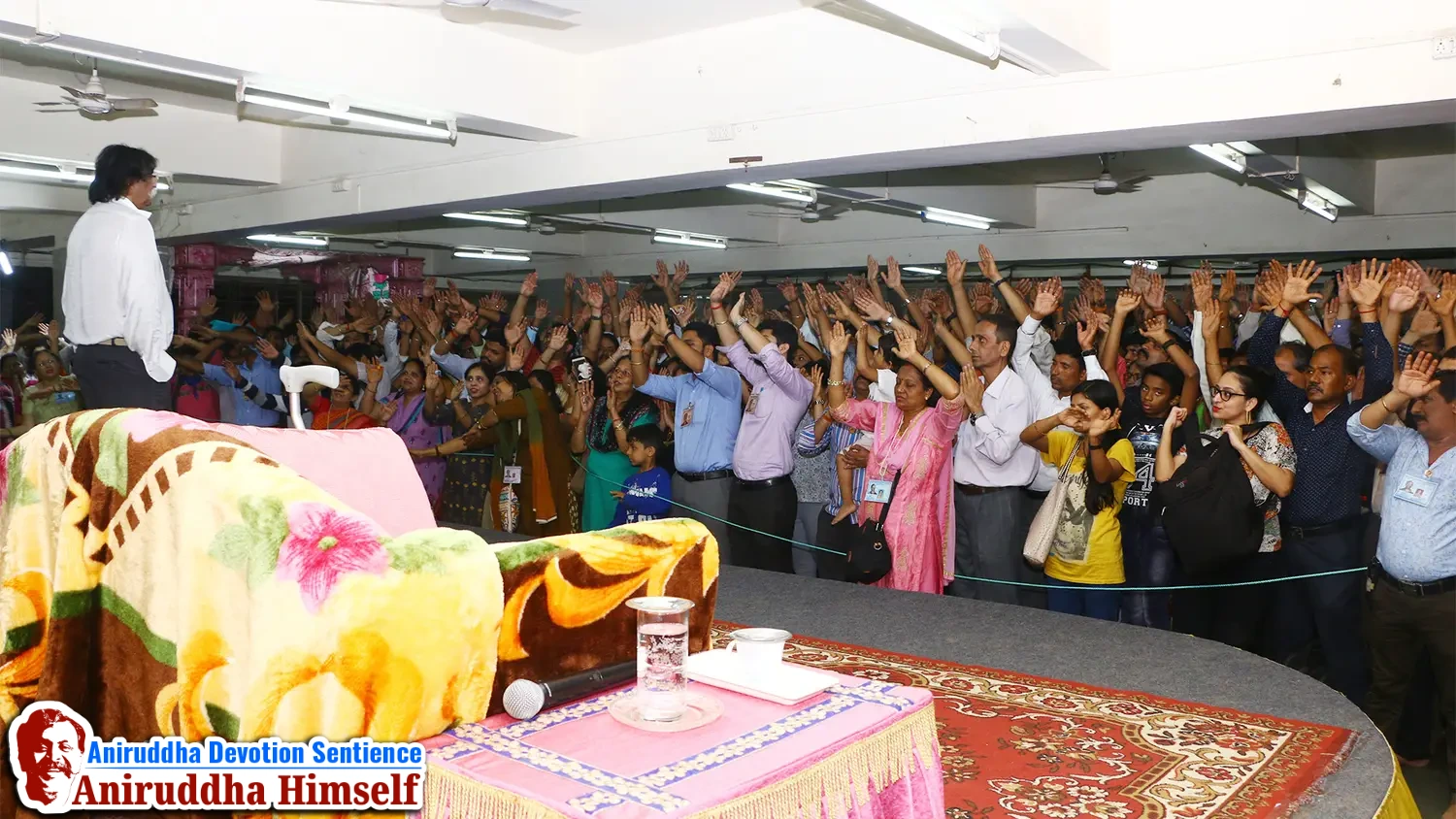
Under Sadguru Shree Aniruddha's guidance, countless Shraddhavans have been chanting sixteen rounds of this sovereign mantragajar daily for many years with profound devotion and they continue to receive numerous experiences of its divine grace.
click here to watch all the anubhavs of The Sovereign Mantragajar of Swayambhagwan Shree Trivikram