A Doctor Who Never Stopped Learning
Bapu's passion for learning is rooted in his academic journey. After studying at Dr. Shirodkar High School in Mumbai, he pursued medicine at Topiwala National Medical College and Nair Hospital, earning his MBBS in 1978 and MD in Medicine in 1982. He later served there as a lecturer before starting his practice as a specialist doctor.
Medicine demands continuous study, and that discipline became a lifelong habit for Bapu. Even after establishing himself professionally, he continued exploring subjects beyond his field in science, technological innovation, finance, management and history.
‘Remain a Student Throughout Your Life’
Bapu often recalls that his school and college friends jokingly called him 'Ghaasu' - a Marathi expression for someone who studies relentlessly – a nickname he embraced with pride. He frequently reminds his followers:
‘Once school or college ends, most people stop studying. Instead, we should remain students throughout our lives.’
In his view, learning is not merely the accumulation of information; it requires us to keep observing, understanding, adapting and improving. When a person begins to believe that there is nothing more to learn, the acquisition of new knowledge gradually comes to a standstill.
The Ancient Spirit of the 'Satra' in a Modern Seminar
One of Bapu’s most distinctive means of promoting learning is the seminar. He explains that the word comes from the Latin word ‘seminarium,’ meaning a seedbed or a place where growth is nurtured. He also relates the seminar to the 'Satras' of India's ancient Gurukul tradition, in which discussions, questioning and collective exploration were central to education.
A seminar, therefore, is not merely a lecture. An individual or a group of individuals study a subject extensively and presents it systematically, enabling others to understand complex ideas more efficiently and explore them further. Participants, too, must remain sincere students – listening thoughtfully, asking questions, verifying information and continuing to learn independently.
Building a Culture of Intellectual Curiosity
Alongside spirituality, Sadguru Bapu has consistently encouraged the study of contemporary developments that shape everyday life. He believes that a spiritually aware person must also be an informed citizen who understands a rapidly changing world. The seminars conducted under his guidance have therefore brought together subjects ranging from science, technology and communication to finance and geopolitics. The purpose is not to acquire scattered facts, but to develop a balanced outlook that supports intellectual, personal and spiritual growth.
The Visionary Mega Seminars
Among the numerous seminars organised under Sadguru Bapu's guidance, two extensive seminars personally conducted by him in 2012 and 2013 are particularly noteworthy viz., ‘Strategies of the New Era’ and ‘How the World Is Going to Be’.
Strategies of the New Millennium
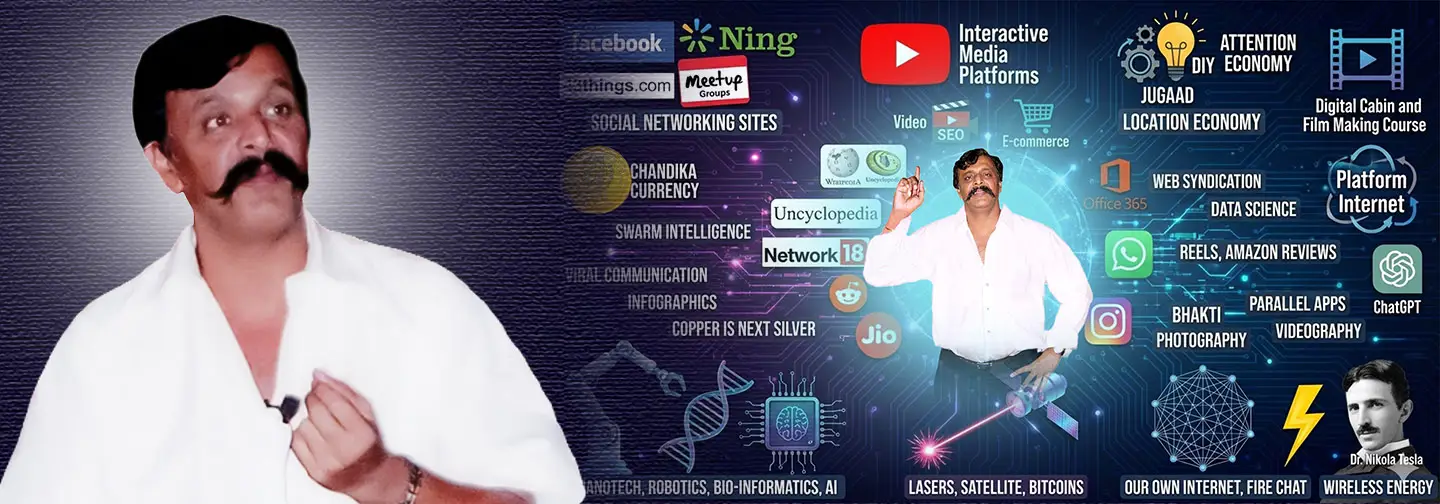
Held in 2012, this marathon seminar comprised nearly twenty-eight hours of sessions over two days. Bapu presented ideas and technologies such as 'Jugaad', Emotional Intelligence, the Attention Economy, 3D Printing, Cloud Computing, Personal Cloud, the Blogosphere, NPTEL and digital education, open-source software and Ham Radio. At a time when several of these subjects were not yet part of everyday discussion, the seminar invited participants to understand their possible long-term significance.
“How the World Is Going to Be”
In the 2013 seminar, Bapu introduced participants to Artificial Intelligence, holography, nanotechnology and robotics, among other emerging fields. The prominence these technologies have since gained reflects his close attention to developments that were likely to influence the future. More importantly, he encouraged participants to approach such change with curiosity and preparedness rather than apprehension.
Teaching by Example
ASadguru Bapu believes in practising before preaching and leads by example before guiding others. He studies a subject deeply and develops a thorough understanding of it before speaking about it. Once he has gained a firm grasp of a topic, he motivates volunteers and members of his organisations to study it further, especially from the perspective of practical implementation.
Presentations often held in his office become collaborative learning experiences. Bapu joins the discussion, contributes insights and gently corrects inaccuracies. In the process, participants learn to search, research, analyse and verify information, while also gaining confidence in presenting their findings.
From Nikola Tesla to the Cloud-based Remote Office
The breadth of this learning culture can be seen in seminars devoted to very different subjects. One nearly twelve-hour seminar explored the life, struggles, discoveries and enduring influence of the inventor Dr. Nikola Tesla, including his contribution to alternating-current electricity and the foundations of wireless communication.
In November 2019, Bapu organised an extensive seminar on the ‘Cloud-based Remote Office’ and productivity tools. Within months, the COVID-19 pandemic compelled workplaces worldwide to move online. The prior training helped volunteers move organisational activities to digital platforms, support paperless workflows and collaborate remotely. During restricted physical interaction, these connections also helped sustain togetherness and continuity.
Other seminars addressed interactive media platforms, social media platforms, digital dashboards among others, reflecting the need to remain informed about developments that may affect our lives.
Entering the Age of Artificial Intelligence
As Artificial Intelligence began transforming education, communication, and everyday life, Sadguru Bapu once again advocated the systematic application of AI in daily routines and tasks rather than just passive observation. Beginning in 2025, he initiated seminars on Artificial Intelligence, generative AI tools, emerging technologies, QR codes and their practical applications. His emphasis has not been merely on familiarity with new tools, but on understanding how they work, recognising their possibilities and limitations, and learning to use them thoughtfully, responsibly and effectively.
Knowledge Must Serve Humanity
Throughout his seminars, Sadguru Bapu emphasizes that knowledge acquires true value only when it serves humanity. Information without a sense of responsibility can be dangerous, while technology without ethics may create new problems instead of solving existing ones. Accordingly, his writings and discourses present science and spirituality as complementary. Rational inquiry helps dispel superstition and broadens understanding, while spiritual values guide the responsible and compassionate use of knowledge for the welfare of society.
Words That Continue to Inspire
Two quotations frequently recalled by Sadguru Bapu offer a glimpse into the approach to learning that he consistently encourages. He interprets technology visionary Steve Jobs's
'Stay Hungry, Stay Foolish'
as an invitation to retain the desire to learn and the courage to experiment with unconventional ideas. He also cites agricultural scientist and inventor George Washington Carver:
'Start where you are, with what you have; make something of it and never be satisfied.'
Together, they embody continuous self-improvement.
In fact, this approach is not limited to formal seminars. Bapu's discourses themselves often become a form of learning, encouraging listeners to think, analyse and understand rather than merely listen.
A Legacy of Learning
The seminars initiated by Sadguru Aniruddha Bapu go far beyond the sharing of knowledge. They encourage a way of living in which learning never stops. By continuing to learn, we keep our minds active, broaden our understanding and become better prepared to understand the changes taking place around us. However, at the same time, this pursuit of knowledge must remain firmly rooted in Bhakti. For Sadguru Bapu, Bhakti and knowledge are among the greatest treasures a person can possess – treasures that no one can steal.